It's been a while since I've posted anything philosophical on my blag and my homework that was due tomorrow is now due next Wednesday, so I have a little free time to blag.
I'll be speaking on these issues as an American, but many of the ideas that I present will be applicable to all of western society.
Let me start off this post by saying that I'm a registered Republican and I voted for Mitt Romney (somewhat begrudgingly). I'm an almost universal social conservative, being pro-life, pro-gun, pro-religion, pro-self sufficiency, pro-drilling, pro-fracking, and pro-logging. I'm aligned with the conservative base of the Republican party on basically every issue... except one. Unfortunately, that one issue is the hottest topic in the entire political sphere of western society.
Many of my super-conservative friends seem to extol capitalism as if it's a universal virtue sent by revelation from Heaven for the benefit of mankind. In reality, capitalism is an extreme on the opposite side of the economic system spectrum from socialism. Either one, in pure form, is just as likely to collapse in on itself and to leave society in ruin. Many pundits on both sides of the aisle would have you believe that these two ideals are mutually exclusive, when in reality, any functional society requires balanced elements of both self service (capitalism) and social service (socialism).
Any blue-blooded American who's not a clove-smoking hippie can tell you why pure socialism, aka communism, doesn't work. Under this sort of system, all people work for the benefit of the whole and resources are distributed as evenly as possible. Any individual's prosperity is not based on how hard or how effectively that one person works, but on how well people work around him or her. Under a purely socialist system, it's easy to give a minimal effort and receive a similar reward, because everyone around you can pick up your slack. However, when too many people do this, the system collapses because nothing actually gets done. Communism is the liberal extreme of the economic system spectrum and does not provide sufficient individual incentive to be sustainable.
In contrast, many Americans seem to have difficultly identifying why pure capitalism doesn't work, even though the answer should be more obvious to an objective observer (if such a person exists). Part of this phenomenon is probably due to the fact that essentially pure socialist economies have existed for relatively short periods of time. Nazi Germany, Soviet Russia, and Red China (until more recently) are all good examples of societies that existed for a time with more or less socialist economies and eventually collapsed or, in the case of China, transitioned to a sort of pseudo-capitalism. On the other hand, a purely capitalist society has either never existed or didn't last long enough to create any lasting records. There are basically two reasons why. One should be obvious, though people seem to have a hard time grasping it, and the other is more subtle.
First, I have two words for you: Market Failures. A purely capitalist economy is incapable of providing certain public goods that are essential for a healthy, functional society. Two excellent examples of market failures of public goods are the military and civil infrastructure. There are several others both in and out of the realm of public goods, but these two are among the best simple examples. These public goods can only be provided by a socialist system. Many conservatives would balk at the idea that the military is a socialist program, but these folks haven't really thought about it. For this program, the government is taking a little bit of wealth from everyone in order to preserve the nation as a whole. The military is certainly not the most socialist system set up by the federal government, but it's along the same lines. As far as public infrastructure goes, I'll let POTUS speak for himself. Mitt Romney's heyday of taking this quote out of context made it slightly painful to vote for him.
If a society has a system that provides for these essential public goods, it is not a purely capitalist society. These things can only be provided by a system that is inherently socialist in that it takes some proportion of the wealth from the populace in order to provide for the general welfare. If a society does not have these public goods, there is a very high probability that it will soon collapse and be replaced by a society that does.
Now that we've covered what should be obvious, let's move on to the more subtle. I've said for a few years now that an economist is also a political philosopher, even if he/she is a really bad political philosopher. The ideas and analyses of wealth and trade cannot be totally divorced from those of power. Not only does material wealth, in and of itself, bring power with it, those who are powerful are also more capable of obtaining material wealth by virtue of their power. Free-market economics assumes that men would rather trade than steal. While this is often true, there are clearly those who are willing to break to rules for the sake of wealth and increased power.
Any society that doesn't, at least somewhat, regulate the exertions of the powerful upon the weak, will eventually fail. Power held by individuals and small groups leads to isolation of those individuals and groups from the rest of the populace. Essentially, the very few ruling elite sit in a gated inclosure atop a hill and manage the numerous lower classes remotely. A society in this state is volatile and there are many ways in which it can fail. One way is that the powerful do not allocate enough of their wealth for public goods, resulting in a market failure, as previously mentioned. Another is the small groups of the powerful spending resources to fight against each other, attempting to shrink the others' wealth and power, until the society collapses by attrition (see next paragraph). There's also my personal favorite, which is united rebellion by the weak against the powerful. Though few individuals may hold large quantities of power, a large majority is almost always more powerful in aggregate. This rebellion can manifest itself as a peaceful refusal to work for the powerful, at some personal risk, or blood can flow down the streets of Paris (figuratively speaking:). Regardless of the precise circumstances, a society that does not prevent the powerful from becoming too powerful will fall eventually.
It's been asked before how deregulation of economic players can possibly lead the economy to shrink. I have another word for you: Rent-seeking. Economic regulation is only universally bad if it's assumed that all participants in a capitalist economy are acting to grow their wealth in absolute terms and not merely relative to the wealth of others. Rent-seeking is essentially using one's wealth and power to gain a larger proportion of the existing wealth, rather than creating new wealth. Left unchecked, rent-seekers will almost universally shrink the total wealth available and cause a society to decline. A purely capitalist society has no checks for the power plays of rent-seekers that can lead to economic and societal decline and collapse.
I said at the beginning of this post that both pure capitalism and pure socialism are extremes in the spectrum of economic systems and neither can exist in a functional society, at least not for very long. As such, there is a need for balance between elements of both self service and social service. For the political problems faced in much of the western world, I like the application of the far eastern philosophy of Yin and Yang. For the description of this philosophy, I give mad props to whoever wrote the opening line of the Wikipedia article I just linked above. It's pure gold. "In Chinese philosophy, the concept of Yin-Yang, literally meaning 'shadow and light,' is used to describe how polar opposites or seemingly contrary forces are interconnected and interdependent in the natural world, and how they give rise to each other in turn in relation to each other." Capitalism and socialism are polar opposite and seemingly contrary ideas that necessarily have to be applied in tandem in order to maintain a healthy and functional society. Without essential elements of both schools of thought, a society will collapse sooner, rather than later.
You can consider capitalism to be light and socialism to be darkness, if that helps you. It really doesn't matter.
They think I don't know a buttload of crap about the Gospel, but I do.
Friday, November 16, 2012
Saturday, October 13, 2012
BYU vs. Oregon State Gameday
Today, my Alma Mater plays my new, substitute Alma Mater in football. I'll be cheering for the team that would win an IRL mascot cage match (in impressive fashion). I have the unique opportunity of knowing both of these teams very well, so I will offer an extended preview of today's matchup.
Prediction:
Even Sean Mannion would have had trouble with BYU's defense in Provo. Cody Vaz, making his first career start, in LaVell Edwards Stadium against this monster of a D, has little to no shot. I'm assuming that Riley Nelson is going to start and play most of the game. If that's not the case, we're looking at 3-0 game in 3OT. BYU's offense has struggled, but should be able to find some renewed life behind a renewed Riley Nelson.
BYU - 13, Oregon State - 6
Player to watch: BYU QB Riley Nelson
Matchup to watch: BYU WR Cody Hoffman vs. OSU CB Jordan Poyer
Stat to watch: Cody Vaz Turnovers
Keys to the Game
BYU
Play smart on offense
Take advantage of turnovers
Kick the ball through the uprights
Oregon State
Protect Cody Vaz
Contain Riley Nelson
Execute in the Red Zone
Even Sean Mannion would have had trouble with BYU's defense in Provo. Cody Vaz, making his first career start, in LaVell Edwards Stadium against this monster of a D, has little to no shot. I'm assuming that Riley Nelson is going to start and play most of the game. If that's not the case, we're looking at 3-0 game in 3OT. BYU's offense has struggled, but should be able to find some renewed life behind a renewed Riley Nelson.
BYU - 13, Oregon State - 6
Player to watch: BYU QB Riley Nelson
Matchup to watch: BYU WR Cody Hoffman vs. OSU CB Jordan Poyer
Stat to watch: Cody Vaz Turnovers
Keys to the Game
BYU
Play smart on offense
Take advantage of turnovers
Kick the ball through the uprights
Oregon State
Protect Cody Vaz
Contain Riley Nelson
Execute in the Red Zone
Tuesday, September 11, 2012
Favorites
So, it's the time of year when professional and collegiate sports abound and everyone can follow their favorite teams. I've recently been thinking about what my favorite teams are in each of the sports I follow... and conversely, which teams are my least favorite. Here are a few lists of my top 5 favorite and most despised teams in each of the 4 sports leagues I enjoy watching most.
NCAA Football
Favorite
1. BYU Cougars
2. Whoever's playing SpUtah
3. Oregon State Beavers
4. Georgia Tech Yellow Jackets
5. Air Force Falcons
Least Favorite
1. SpUtah SpUtes
2. Another Ohio State Buckeyes
3. University of Spoiled Children (USC) Trojans
4. Texas (not so) Christian Horned Frogs
5. Florida Gators
Major League Baseball
Favorite
1. Colorado Rockies
2. Los Angeles Angels of Anaheim
3. Houston Astros
4. Texas Rangers
5. Toronto Blue Jays
Least Favorite
1. Arizona D-bags
1. Los Angeles Dodgers
1. San Francisco Giants
4. Atlanta Braves
5. New York Yankees
5. Boston Red Sox
NFL Football
Favorite
1. Denver Broncos
2. Baltimore Ravens
3. Houston Texans
4. Atlanta Falcons
5. Arizona Cardinals
Least Favorite
1. Oakland Raiders
2. New England Patriots
3. Green Bay (Fudge) Packers
4. Kansas City Chefs (Yes, I misspelled that on purpose)
5. Pittsburgh Steelers
NHL Hockey
Favorite
1. Colorado Avalanche
2. Montreal Canadiens
3. St. Louis Blues
4. Winnipeg Jets
5. New York Rangers
Least Favorite
1. Detroit Red Wings
2. Vancouver Canucks
3. Anaheim Ducks
4. Calgary Flames
5. Minnesota Wild
Some of these have interesting stories behind them, but I'm not going to go into detail. If you're curious about any of my selections, I'll be glad to reveal my reasoning. It's also noteworthy that there are a couple of cities with which I have a very ambivalent sports relationship, namely LA and Atlanta.
NCAA Football
Favorite
1. BYU Cougars
2. Whoever's playing SpUtah
3. Oregon State Beavers
4. Georgia Tech Yellow Jackets
5. Air Force Falcons
Least Favorite
1. SpUtah SpUtes
2. Another Ohio State Buckeyes
3. University of Spoiled Children (USC) Trojans
4. Texas (not so) Christian Horned Frogs
5. Florida Gators
Major League Baseball
Favorite
1. Colorado Rockies
2. Los Angeles Angels of Anaheim
3. Houston Astros
4. Texas Rangers
5. Toronto Blue Jays
Least Favorite
1. Arizona D-bags
1. Los Angeles Dodgers
1. San Francisco Giants
4. Atlanta Braves
5. New York Yankees
5. Boston Red Sox
NFL Football
Favorite
1. Denver Broncos
2. Baltimore Ravens
3. Houston Texans
4. Atlanta Falcons
5. Arizona Cardinals
Least Favorite
1. Oakland Raiders
2. New England Patriots
3. Green Bay (Fudge) Packers
4. Kansas City Chefs (Yes, I misspelled that on purpose)
5. Pittsburgh Steelers
NHL Hockey
Favorite
1. Colorado Avalanche
2. Montreal Canadiens
3. St. Louis Blues
4. Winnipeg Jets
5. New York Rangers
Least Favorite
1. Detroit Red Wings
2. Vancouver Canucks
3. Anaheim Ducks
4. Calgary Flames
5. Minnesota Wild
Some of these have interesting stories behind them, but I'm not going to go into detail. If you're curious about any of my selections, I'll be glad to reveal my reasoning. It's also noteworthy that there are a couple of cities with which I have a very ambivalent sports relationship, namely LA and Atlanta.
Thursday, September 6, 2012
Bombshell
Before I begin, I want to make sure that you're caught up on the back story.
When I was 18.75 years old, I turned in papers to serve a full-time, proselyting mission for the Church of Jesus Christ of Latter-day Saints. A couple weeks later, I was asked to complete an additional medical evaluation to determine if I could serve in the field without the medication I was taking at the time. The evaluator determined that I was in need of the medication in question and, thus, could not serve a mission, because this substance was not allowed in the mission field. My branch president pulled me into his office and told me I wouldn't be getting a call in April of '07.
After this, I went to BYU, met a couple crazy girls, made some great friends, and made tons of people feel awkward in social situations. Best time of my life (so far). I graduated, couldn't find a job, sat around for a while and now I'm in grad school at Oregon State. You know that part of the story.
Now fast forward to the 24th of August 2012, almost two months after I had been through the temple for my own endowments.
During the previous days, I had been contemplating what I should do with my life and what my plans should be after graduation. As I awoke that morning, I had a very distinct, unmistakable impression that I should try again to serve a full-time, proselyting mission in my youth. I tried to dismiss this impression like Jonah and hop the next ship to Tarshish. This wasn't the first time since I'd been deemed ineligible that the thought had occurred to me. However, at other times, it has been easy to push out of my mind and dismiss as a stupor of thought. This time it stuck with me. I had already planned to return to the temple that day to do an endowment session. As I was sitting in the celestial room, I prayed as to what I should do in my future and if I should again try to serve a mission in my youth. I received another impression in accord with the first.
As it turns out, I actually took two different medications when I was 18.75 years old. For semantics' sake, we'll call one of them Pyridoxine and the other Tocopherol (not their real names). For years following my non-call, I had always assumed that it was the Pyridoxine that had kept me from serving. This is most likely from my own, internal bias resulting from the fact that that medication was more vital to my well-being than the Tocopherol. In reality, Tocopherol was a newer, more powerful, and more closely monitored medication (though it had received FDA approval, for what that's worth). In the years following, I've continued to take the Pyridoxine, but stopped taking the Tocopherol a couple years back, as it was no longer particularly necessary.
I talked with my bishop the following Sunday and asked him to contact the missionary department on my behalf. It turns out that a young man is allowed to serve while on the medication that I've code named Pyridoxine, assuming that he can pass the same medical evaluation I underwent 5 years ago. Yesterday, I went to Eugene to undergo another evaluation. The evaluator said that she'd be glad to recommend me to serve a mission.
As I contemplate this concept, it makes the whole of my life since I turned 18 make much more sense. I was not called when I was 19 because the Lord wanted my grandfather to be able to supplement my education. When I sought to marry a young woman (or two) the answer was a resounding 'no' because the Lord still wanted me to serve. The Lord lead me almost forcibly to Oregon State University so that I could be prospered financially and be around people who would help me come to the conclusion that I should try again to serve a mission. I even think the Lord prompted my bishop to ask when he did if I wanted to go through the temple for my endowments so that my spiritual eyes could be more fully opened and I could receive these revelations. Without the clarity the endowment has brought me, I would almost certainly not be making this post.
Then there's the financial prosperity the Lord has brought me itself. For the last year, or so, I've kind of been wondering what I'd do with the big pile of money with which I've been blessed. I figured I'd use it to pay down my student loans and/or help get myself set up when I graduated and/or get myself a motorcycle. I was wrong on the last two accounts and mostly wrong on the first one. At this point the two biggest hurdles to my missionary service are the aforementioned student loans and some dental work. My teeth aren't nearly as pristine as they were in 2007. (Seriously, I had gorgeous teeth.) Now, I'll need at least 2 fillings, probably a[n inlay], and hopefully not too obscenely much in my roots. With the big pile of cash with which I've been blessed, I should have enough to make 25+ payments on my student loans, get the dental work done, and pay for most of my mission, assuming the dental work isn't absolutely obscene. My path has clearly been blessed by the hand of God.
At this point, my plan is to finish my master's degree as planned and graduate in June of next year. It's unlikely that I'll be ready much before that time, regardless. I will probably begin papers in February or March and submit them in May for a July availability date. At no point in this process will I absolutely assume that I will be getting a mission call. I have learned to not be pretentious. Though it seems very likely that I will get a call, I'm perfectly willing to accept the possibility that I, again, won't. I ask that you take a similar approach for me and any other prospective missionaries. I'd really appreciate it.
However, I'm more than happy to accept predictions. If you're going to make one, I recommend taking into account that I will be taking a medication, though that medication is fairly easy to get and fairly cheap. Still, I think somewhere in the US or Canada would be the most realistic prediction. If I had the luxury of hand-picking a mission, I'd want to go to Winnipeg, Manitoba, because I like Canada and Manitoba, Saskatchewan, and western Ontario seem like good places. Yes, I know it would be wicked-cold there; hand warmers would be a must. If I was to log a more realistic prediction, I'd say [Arcadia], California speaking Spanish, because that's where East LA is and I have a sneaking suspicion that the Lord wants me to learn to love illegal immigrants, even if I don't accept their life choices.
Updates will most certainly follow.
When I was 18.75 years old, I turned in papers to serve a full-time, proselyting mission for the Church of Jesus Christ of Latter-day Saints. A couple weeks later, I was asked to complete an additional medical evaluation to determine if I could serve in the field without the medication I was taking at the time. The evaluator determined that I was in need of the medication in question and, thus, could not serve a mission, because this substance was not allowed in the mission field. My branch president pulled me into his office and told me I wouldn't be getting a call in April of '07.
After this, I went to BYU, met a couple crazy girls, made some great friends, and made tons of people feel awkward in social situations. Best time of my life (so far). I graduated, couldn't find a job, sat around for a while and now I'm in grad school at Oregon State. You know that part of the story.
Now fast forward to the 24th of August 2012, almost two months after I had been through the temple for my own endowments.
During the previous days, I had been contemplating what I should do with my life and what my plans should be after graduation. As I awoke that morning, I had a very distinct, unmistakable impression that I should try again to serve a full-time, proselyting mission in my youth. I tried to dismiss this impression like Jonah and hop the next ship to Tarshish. This wasn't the first time since I'd been deemed ineligible that the thought had occurred to me. However, at other times, it has been easy to push out of my mind and dismiss as a stupor of thought. This time it stuck with me. I had already planned to return to the temple that day to do an endowment session. As I was sitting in the celestial room, I prayed as to what I should do in my future and if I should again try to serve a mission in my youth. I received another impression in accord with the first.
As it turns out, I actually took two different medications when I was 18.75 years old. For semantics' sake, we'll call one of them Pyridoxine and the other Tocopherol (not their real names). For years following my non-call, I had always assumed that it was the Pyridoxine that had kept me from serving. This is most likely from my own, internal bias resulting from the fact that that medication was more vital to my well-being than the Tocopherol. In reality, Tocopherol was a newer, more powerful, and more closely monitored medication (though it had received FDA approval, for what that's worth). In the years following, I've continued to take the Pyridoxine, but stopped taking the Tocopherol a couple years back, as it was no longer particularly necessary.
I talked with my bishop the following Sunday and asked him to contact the missionary department on my behalf. It turns out that a young man is allowed to serve while on the medication that I've code named Pyridoxine, assuming that he can pass the same medical evaluation I underwent 5 years ago. Yesterday, I went to Eugene to undergo another evaluation. The evaluator said that she'd be glad to recommend me to serve a mission.
As I contemplate this concept, it makes the whole of my life since I turned 18 make much more sense. I was not called when I was 19 because the Lord wanted my grandfather to be able to supplement my education. When I sought to marry a young woman (or two) the answer was a resounding 'no' because the Lord still wanted me to serve. The Lord lead me almost forcibly to Oregon State University so that I could be prospered financially and be around people who would help me come to the conclusion that I should try again to serve a mission. I even think the Lord prompted my bishop to ask when he did if I wanted to go through the temple for my endowments so that my spiritual eyes could be more fully opened and I could receive these revelations. Without the clarity the endowment has brought me, I would almost certainly not be making this post.
Then there's the financial prosperity the Lord has brought me itself. For the last year, or so, I've kind of been wondering what I'd do with the big pile of money with which I've been blessed. I figured I'd use it to pay down my student loans and/or help get myself set up when I graduated and/or get myself a motorcycle. I was wrong on the last two accounts and mostly wrong on the first one. At this point the two biggest hurdles to my missionary service are the aforementioned student loans and some dental work. My teeth aren't nearly as pristine as they were in 2007. (Seriously, I had gorgeous teeth.) Now, I'll need at least 2 fillings, probably a[n inlay], and hopefully not too obscenely much in my roots. With the big pile of cash with which I've been blessed, I should have enough to make 25+ payments on my student loans, get the dental work done, and pay for most of my mission, assuming the dental work isn't absolutely obscene. My path has clearly been blessed by the hand of God.
At this point, my plan is to finish my master's degree as planned and graduate in June of next year. It's unlikely that I'll be ready much before that time, regardless. I will probably begin papers in February or March and submit them in May for a July availability date. At no point in this process will I absolutely assume that I will be getting a mission call. I have learned to not be pretentious. Though it seems very likely that I will get a call, I'm perfectly willing to accept the possibility that I, again, won't. I ask that you take a similar approach for me and any other prospective missionaries. I'd really appreciate it.
However, I'm more than happy to accept predictions. If you're going to make one, I recommend taking into account that I will be taking a medication, though that medication is fairly easy to get and fairly cheap. Still, I think somewhere in the US or Canada would be the most realistic prediction. If I had the luxury of hand-picking a mission, I'd want to go to Winnipeg, Manitoba, because I like Canada and Manitoba, Saskatchewan, and western Ontario seem like good places. Yes, I know it would be wicked-cold there; hand warmers would be a must. If I was to log a more realistic prediction, I'd say [Arcadia], California speaking Spanish, because that's where East LA is and I have a sneaking suspicion that the Lord wants me to learn to love illegal immigrants, even if I don't accept their life choices.
Updates will most certainly follow.
Saturday, August 18, 2012
Mistborn Trilogy, take 1
In my life, I haven't been known for reading works of fiction very often, nor of particularly enjoying them when I do. However, there are key exceptions, like semi-physics-based sci-fi/fantasy novels that address realistic human concerns. In recent years, I've read both the Harry Potter septology and Ender's Game and enjoyed both of them very much.
This June, I asked my lovely, awesome friend Bridget what her book recommendations would be for me this summer. Her and I have similar interests in books, but she reads more than I do, so I can always count on her for a good recommendation. She said that I absolutely had to read the Mistborn Trilogy, by Brandon Sanderson and that it had replaced Ender's Game as her favorite book in the history of books. Naturally, I went down to the bookstore and picked up the entire trilogy in a paperback box set.
They were awesome.
The remainder of this post will be dedicated to my thoughts on each book in the series without giving away too much. If you haven't read this series, go out and get it right now, because it's just that good. I'll try my best to avoid the worst spoilers, but in order to adequately describe my thoughts on these books, I have to give a few things away.
Mistborn: The Final Empire
Sanderson describes this story as a fantasy/heist story/kung fu epic, and I think that's a pretty good description. The story is about a young, orphaned street urchin named Vin who gets recruited by a specialized thieving crew to try to pull off an almost impossible task in assassinating their world's emperor god. Vin is pulled into this thieving crew because she possesses a rare form of magic called Allomancy, which allows the user to harness power from metals they ingest. Because she possesses all of the powers, as opposed to just one of them, she is called a Mistborn, the namesake of the series.
Throughout this book and its two sequels, I was really impressed with Sanderson's efficiency in telling a story with only a few words. Though this book is fairly long, it packs a large quantity of plot and character development into each of its pages. There are almost no wasted words and at no point in this novel did I question the author's decisions in placing words, sentences, or section where they were. This novel and this series were very well done and I can appreciate basically everything that Sanderson chose to do throughout.
Having finished the series, I can really appreciate the contrast that Sanderson gives with symbols and character development. A large portion of this story is given to Vin's development as she changes from an abused, paranoid shell of a person into the confident, trusting young woman she becomes. I particularly appreciated her internal monologs in which she states that the 'real' her is neither the street urchin that she was, nor the young country noblewoman she was pretending to be, but something in between. I found that particular contrast to be impressive.
My favorite character throughout this novel and throughout this series was Sazed, the Terrisman. He is first introduced in chapter 8 (I believe) of Mistborn and remains an important character throughout the series. Almost immediately, he is shaped as a tall, but gentle scholar who seeks to fulfill his role in life, but also seeks to effect change however he can while living that role. Needless to say, I felt an immediate connection and followed him closely as I read each book.
The resolution to this book is unexpected. Unless you're somehow clairvoyant or have already read or heard a spoiler, you won't see the end to this book coming. It was probably even more so for me. For good or ill, I often like to read the last sentence of a book before I even start just to give me a feel for how the book with end. Sometimes this reveals epic spoilers, but more often, it just gives me a general idea of the feelings the author is trying to convey by the ending of the book. (I read the end of chapter 38, not the epilogue.) In this case, it was something of a spoiler, but not unforeseen, given the context of the book. However, I managed to misread the pronoun in the last sentence replacing a 'he' for the 'she' that was actually there. This lead me to believe that Kelsier took up Vin's role at the end of the book. As the resolution unfolded, my mind blew apart, leaving little chunks of brain all over my apartment. It was that good and made even better by my initial misread of the final sentence.
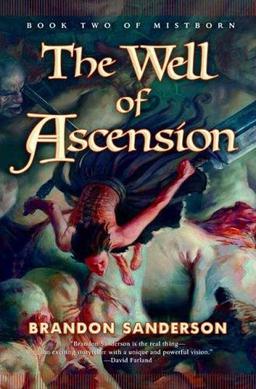
The Well of Ascension
This book is a continuation of the story from the first Mistborn book. Vin, Elend, and much of Kelsier's crew try to establish a government in place of the Lord Ruler's regime and face many challenges to their authority and legitimacy. Additionally, Vin has to struggle through her feelings of love and affection for Elend and another man who she believes might understand her better. And they do, eventually, find the Well of Ascension.
Of the three books in this trilogy, this one was my least favorite as a stand-alone novel. It proved to be an excellent bridge between the premier, Mistborn, and the finale, The Hero of Ages, but I didn't particularly enjoy it, in and of itself. Of the three books, this one is the longest (just slightly) and contains the least change from beginning to end in setting, scope, and plot. At the end of the story, the characters are basically in the same place they were left at the end of Mistborn, except with one big, new problem on their hands. I thought the parts of establishing and re-establishing the government of the land and Vin's love triangle, particularly, took too long and could have used to be more concise. Brandon Sanderson was still good at fitting a lot of plot and character development into a few pages, but I thought he could have done better with those two particular parts.
This story is not as much about the plot itself as it is about the character development. This is another problem with this book as a stand-alone novel: it serves as a great prelude to the Hero of Ages with some excellent character development that sets up that story very well, but doesn't accomplish that much in its own plot. I generally appreciated the character development of Vin, Elend, Breeze, and Spook, but I cannot say the same for the development of my favorite character. In this book, Sazed is given a brief taste of that one thing he's wanted all his life, then has it ripped away from him, leaving him a sad, empty shell of a man, doubting even his most firm internal convictions. Objectively speaking, the character development is probably good, it just hit way too close to home for me to really appreciate it.
In the end, Vin, Elend, and Sazed do find the Well of Ascension, and we're left with something of a cliffhanger as to what will happen to the main characters and the world in which they live. Again, this gives great setup for the epic finale, but does not lead to a great resolution for the novel itself.
The Hero of Ages
Instead of the main plot conflict coming from physical armies, it is derived more from intangible powers. There is still plenty of physical confrontation, as this is a theme of all three books, but the primary conflict comes mostly from outside, metaphysical powers. Just when everything seems hopeless, the Hero of Ages is able to ascend and to make things right.
This is pretty much now my favorite book in the history of books. Everything that seemed to go wrong in The Well of Ascension was corrected in The Hero of Ages. It blew my mind all over the place, and I love it.
The theme of contrast that I appreciated in Mistborn was even more apparent in Hero of Ages in the contrast between Preservation and Ruin. The mists, which are of Preservation, are white, while the ash increasingly coming from the ashmounts, a tool of Ruin, are black. Additionally, I like that Sanderson made Vin a type of Ruin with her ability to destroy and to wreak havoc on her enemies and Elend a type of Preservation with his desire to maintain peace and order. This effect is magnified when one considers that Vin predominantly wears black and Elend wears his white suits given to him in the previous novel. That particular effect is easier to catch when you read the paperback version as opposed to the hardcover.
I also really like that Sanderson was able to convey a sense of absolute hopelessness through the pages toward the end of this novel. In most stories, one can tell that everything is going to be alright in the end and that the main characters will all be fine. Near the end of this novel, I couldn't help but wonder if everything was going to come crashing down and the resolution would be one that is unhappy, but fitting for the context. I love those kind of books, but I didn't really think this one was going to be one, thus I was supremely pleased with the resolution that Sanderson was able to create.
I also really liked the character development of Spook in this particular novel. Throughout the first two books, Spook is a mostly unimportant and forgettable character. However, in this one, he becomes one of the central characters, overcoming much of his forgettability to become integral to the plot and the well being of the other characters.
The Hero of Ages was just plain awesome.
Over the last couple months, I've really enjoyed reading these books. I've even read the Alloy of Law as well, but I think that'll be a blag post for another day. Though I don't often enjoy fiction, these books are of a genre and style that appeals to me as no other novels really have before. Brandon Sanderson is truly a remarkable author and is able to do things that most other creative writers are just not capable of. These books have captured a place as my favorites and will probably remain so for the foreseeable future.
PS - If you want to check out more of Sanderson's stuff, click here.
This June, I asked my lovely, awesome friend Bridget what her book recommendations would be for me this summer. Her and I have similar interests in books, but she reads more than I do, so I can always count on her for a good recommendation. She said that I absolutely had to read the Mistborn Trilogy, by Brandon Sanderson and that it had replaced Ender's Game as her favorite book in the history of books. Naturally, I went down to the bookstore and picked up the entire trilogy in a paperback box set.
They were awesome.
The remainder of this post will be dedicated to my thoughts on each book in the series without giving away too much. If you haven't read this series, go out and get it right now, because it's just that good. I'll try my best to avoid the worst spoilers, but in order to adequately describe my thoughts on these books, I have to give a few things away.
Mistborn: The Final Empire
Sanderson describes this story as a fantasy/heist story/kung fu epic, and I think that's a pretty good description. The story is about a young, orphaned street urchin named Vin who gets recruited by a specialized thieving crew to try to pull off an almost impossible task in assassinating their world's emperor god. Vin is pulled into this thieving crew because she possesses a rare form of magic called Allomancy, which allows the user to harness power from metals they ingest. Because she possesses all of the powers, as opposed to just one of them, she is called a Mistborn, the namesake of the series.
Throughout this book and its two sequels, I was really impressed with Sanderson's efficiency in telling a story with only a few words. Though this book is fairly long, it packs a large quantity of plot and character development into each of its pages. There are almost no wasted words and at no point in this novel did I question the author's decisions in placing words, sentences, or section where they were. This novel and this series were very well done and I can appreciate basically everything that Sanderson chose to do throughout.
Having finished the series, I can really appreciate the contrast that Sanderson gives with symbols and character development. A large portion of this story is given to Vin's development as she changes from an abused, paranoid shell of a person into the confident, trusting young woman she becomes. I particularly appreciated her internal monologs in which she states that the 'real' her is neither the street urchin that she was, nor the young country noblewoman she was pretending to be, but something in between. I found that particular contrast to be impressive.
My favorite character throughout this novel and throughout this series was Sazed, the Terrisman. He is first introduced in chapter 8 (I believe) of Mistborn and remains an important character throughout the series. Almost immediately, he is shaped as a tall, but gentle scholar who seeks to fulfill his role in life, but also seeks to effect change however he can while living that role. Needless to say, I felt an immediate connection and followed him closely as I read each book.
The resolution to this book is unexpected. Unless you're somehow clairvoyant or have already read or heard a spoiler, you won't see the end to this book coming. It was probably even more so for me. For good or ill, I often like to read the last sentence of a book before I even start just to give me a feel for how the book with end. Sometimes this reveals epic spoilers, but more often, it just gives me a general idea of the feelings the author is trying to convey by the ending of the book. (I read the end of chapter 38, not the epilogue.) In this case, it was something of a spoiler, but not unforeseen, given the context of the book. However, I managed to misread the pronoun in the last sentence replacing a 'he' for the 'she' that was actually there. This lead me to believe that Kelsier took up Vin's role at the end of the book. As the resolution unfolded, my mind blew apart, leaving little chunks of brain all over my apartment. It was that good and made even better by my initial misread of the final sentence.
The Well of Ascension
Of the three books in this trilogy, this one was my least favorite as a stand-alone novel. It proved to be an excellent bridge between the premier, Mistborn, and the finale, The Hero of Ages, but I didn't particularly enjoy it, in and of itself. Of the three books, this one is the longest (just slightly) and contains the least change from beginning to end in setting, scope, and plot. At the end of the story, the characters are basically in the same place they were left at the end of Mistborn, except with one big, new problem on their hands. I thought the parts of establishing and re-establishing the government of the land and Vin's love triangle, particularly, took too long and could have used to be more concise. Brandon Sanderson was still good at fitting a lot of plot and character development into a few pages, but I thought he could have done better with those two particular parts.
This story is not as much about the plot itself as it is about the character development. This is another problem with this book as a stand-alone novel: it serves as a great prelude to the Hero of Ages with some excellent character development that sets up that story very well, but doesn't accomplish that much in its own plot. I generally appreciated the character development of Vin, Elend, Breeze, and Spook, but I cannot say the same for the development of my favorite character. In this book, Sazed is given a brief taste of that one thing he's wanted all his life, then has it ripped away from him, leaving him a sad, empty shell of a man, doubting even his most firm internal convictions. Objectively speaking, the character development is probably good, it just hit way too close to home for me to really appreciate it.
In the end, Vin, Elend, and Sazed do find the Well of Ascension, and we're left with something of a cliffhanger as to what will happen to the main characters and the world in which they live. Again, this gives great setup for the epic finale, but does not lead to a great resolution for the novel itself.
The Hero of Ages
This is pretty much now my favorite book in the history of books. Everything that seemed to go wrong in The Well of Ascension was corrected in The Hero of Ages. It blew my mind all over the place, and I love it.
The theme of contrast that I appreciated in Mistborn was even more apparent in Hero of Ages in the contrast between Preservation and Ruin. The mists, which are of Preservation, are white, while the ash increasingly coming from the ashmounts, a tool of Ruin, are black. Additionally, I like that Sanderson made Vin a type of Ruin with her ability to destroy and to wreak havoc on her enemies and Elend a type of Preservation with his desire to maintain peace and order. This effect is magnified when one considers that Vin predominantly wears black and Elend wears his white suits given to him in the previous novel. That particular effect is easier to catch when you read the paperback version as opposed to the hardcover.
I also really like that Sanderson was able to convey a sense of absolute hopelessness through the pages toward the end of this novel. In most stories, one can tell that everything is going to be alright in the end and that the main characters will all be fine. Near the end of this novel, I couldn't help but wonder if everything was going to come crashing down and the resolution would be one that is unhappy, but fitting for the context. I love those kind of books, but I didn't really think this one was going to be one, thus I was supremely pleased with the resolution that Sanderson was able to create.
I also really liked the character development of Spook in this particular novel. Throughout the first two books, Spook is a mostly unimportant and forgettable character. However, in this one, he becomes one of the central characters, overcoming much of his forgettability to become integral to the plot and the well being of the other characters.
The Hero of Ages was just plain awesome.
Over the last couple months, I've really enjoyed reading these books. I've even read the Alloy of Law as well, but I think that'll be a blag post for another day. Though I don't often enjoy fiction, these books are of a genre and style that appeals to me as no other novels really have before. Brandon Sanderson is truly a remarkable author and is able to do things that most other creative writers are just not capable of. These books have captured a place as my favorites and will probably remain so for the foreseeable future.
PS - If you want to check out more of Sanderson's stuff, click here.
Saturday, July 28, 2012
That Time of Year Again
With my two favorite baseball teams being, unquestionably, the worst two teams in the league, it's time for me to look forward, once again, to football season. Before I really begin, some notes on the coming season:
Unfortunately for the Beavers, looking very similar to what they were last year means that they'll probably look about as bad as thy did last year. I don't think they'll slip against Nicholls State, like they did last year against Sacramento State, but the outlook is still bleak. This team has a lot of young players on both sides of the ball that still haven't quite meshed into a teamed. Though the Pac 12 is largely overrated, it contains good teams with many more talented and more experienced players than OSU's squad. The Beavers are a better team at home than on the road, and this year's home schedule is tougher than last year's, with more teams that are capable of beating OSU.
Record: 3-9
Wins: Nicholls State, @Arizona, Wazzu
Losses: Wisconsin, @UCLA, @BYU, Utah, @UW, Arizona State, @Stanford, Cal, Oregon
This year's civil war game will, once again, go to the Ducks. The Beavers always play well against the Ducks and usually play very well at home. However, the University of Oregon doesn't have to worry about things like "academics," and thus, like much of the SEC, are perennial national championship contenders. The Beavers will, likely, finish last in the Pac 12.
Ducks - 38, Beavers - 24
BYU
With the abomination of a quarterback know as Jake Heaps now being Charlie Weis' problem, the BYU Cougars are set to do at least as well as they did last season. This year's schedule has a good balance of teams throughout, with there being a bit of a cakewalk there at the end. I think (as objectively as possible) that BYU is capable of beating any team on their schedule this year. The games against Utah, Boise State, Notre Dame, and Georgia Tech will be tough, but I think BYU is capable of winning all of those games. Much like last year, the offense should be capable of making plays and the defense will bend occasionally, but won't break often.
Because the Cougars are very likely to win at least six games, they should earn and accept a bowl bid, likely the Poinsettia Bowl in San Diego against a second choice from the Mountain West. Though San Diego State may not finish second in the Mountain West Conference, an SDSU v. BYU Poinsettia Bowl would probably sell as many tickets as any bowl game is going to sell, including the BCS bowls and the National "Championship." Therefore, I'm picking San Diego State to go up against BYU in the Poinsettia Bowl.
Record: 11-2
Wins: Wazzu, Weber St., @Utah, Hawai'i, Utah St., Oregon St., @Georgia Tech, Idaho, @San Jose St., @New Mexico St., (@)San Diego St.
Losses: @Boise St., @Notre Dame
Believe it or not, Riley Nelson hasn't really had a chance to go up against Utah. We can all see that the abomination of a quarterback known as Jake Heaps didn't have what it takes to take on a bitter rival, especially at home. However, Riley Nelson, like the acclaimed, mobile lefty that came before him in BYU history does have it... in abundance. I think Utah goes into this game confident that nothing much has changed in the BYU squad since the end of last year and will realize that they've never actually faced Riley Nelson when the team around him hadn't already given up. Riley, in his one and only opportunity, should be able to go into Rice-Eccles Stadium and bring the Cougars home victorious... by more than 7 points... for the first time in 16 years.
Cougars - 38, Utes - 28
Oregon State @ BYU
This one is going to be no-contest. Last season, BYU beat Oregon State by 10 in Reser Stadium despite not playing their best game. Like I said before, Oregon State plays much better at home than they do on the road and BYU defends LaVell Edwards Stadium well. Riley Nelson will plague the Beavers' defense with his running ability and the Cougars defense will be able to shut down OSU's running game handily. The Beavers will get their points and stay in the game for a while, but it won't be close in the end.
Cougars - 41, Beavers - 20
I'm excited.
- There are about 33 days until the whited out kickoff of my BYU Cougars against the Cougars of Washington State in a game I've affectionately dubbed the 'Cougar Bowl.' I'm going to try to get a pair of tickets to this game and head over to Provo to see it.
- I hate Utah.
- My BYU Cougars, again, take on the Oregon State Beavers, whom I've come to know and love. I'm a Beaver believer when they take on any other opponent, but against my Alma Mater, they're just another team to slash down.
- Both Oregon State and BYU look very similar to what they were last year, for good or ill.
- Though I love OSU, I think I want to travel down to Eugene to take in a Ducks game at Autzen Stadium. I've heard it's loud and awesome, and I'd like to see it for myself.
Unfortunately for the Beavers, looking very similar to what they were last year means that they'll probably look about as bad as thy did last year. I don't think they'll slip against Nicholls State, like they did last year against Sacramento State, but the outlook is still bleak. This team has a lot of young players on both sides of the ball that still haven't quite meshed into a teamed. Though the Pac 12 is largely overrated, it contains good teams with many more talented and more experienced players than OSU's squad. The Beavers are a better team at home than on the road, and this year's home schedule is tougher than last year's, with more teams that are capable of beating OSU.
Record: 3-9
Wins: Nicholls State, @Arizona, Wazzu
Losses: Wisconsin, @UCLA, @BYU, Utah, @UW, Arizona State, @Stanford, Cal, Oregon
This year's civil war game will, once again, go to the Ducks. The Beavers always play well against the Ducks and usually play very well at home. However, the University of Oregon doesn't have to worry about things like "academics," and thus, like much of the SEC, are perennial national championship contenders. The Beavers will, likely, finish last in the Pac 12.
Ducks - 38, Beavers - 24
BYU
With the abomination of a quarterback know as Jake Heaps now being Charlie Weis' problem, the BYU Cougars are set to do at least as well as they did last season. This year's schedule has a good balance of teams throughout, with there being a bit of a cakewalk there at the end. I think (as objectively as possible) that BYU is capable of beating any team on their schedule this year. The games against Utah, Boise State, Notre Dame, and Georgia Tech will be tough, but I think BYU is capable of winning all of those games. Much like last year, the offense should be capable of making plays and the defense will bend occasionally, but won't break often.
Because the Cougars are very likely to win at least six games, they should earn and accept a bowl bid, likely the Poinsettia Bowl in San Diego against a second choice from the Mountain West. Though San Diego State may not finish second in the Mountain West Conference, an SDSU v. BYU Poinsettia Bowl would probably sell as many tickets as any bowl game is going to sell, including the BCS bowls and the National "Championship." Therefore, I'm picking San Diego State to go up against BYU in the Poinsettia Bowl.
Record: 11-2
Wins: Wazzu, Weber St., @Utah, Hawai'i, Utah St., Oregon St., @Georgia Tech, Idaho, @San Jose St., @New Mexico St., (@)San Diego St.
Losses: @Boise St., @Notre Dame
Believe it or not, Riley Nelson hasn't really had a chance to go up against Utah. We can all see that the abomination of a quarterback known as Jake Heaps didn't have what it takes to take on a bitter rival, especially at home. However, Riley Nelson, like the acclaimed, mobile lefty that came before him in BYU history does have it... in abundance. I think Utah goes into this game confident that nothing much has changed in the BYU squad since the end of last year and will realize that they've never actually faced Riley Nelson when the team around him hadn't already given up. Riley, in his one and only opportunity, should be able to go into Rice-Eccles Stadium and bring the Cougars home victorious... by more than 7 points... for the first time in 16 years.
Cougars - 38, Utes - 28
Oregon State @ BYU
Cougars - 41, Beavers - 20
I'm excited.
Monday, July 2, 2012
The House of the Lord
Disclaimer: This post is about LDS (Mormon) temples. As such, this post will be geared toward an LDS audience. If you're not a Latter-day Saint, feel free to read it. There's nothing secret here, but be prepared to be bored out of your mind.
Over the years, I've had a somewhat complicated relationship with the temple of the Lord.
When I was baptized and received the Aaronic priesthood, I was able to go to the temple to do baptisms and I thought it was the coolest thing ever. I felt like I really had a connection to those who had passed on and like I was doing something that was good and right in the eyes of God. That experience was also the topic on which I gave my first sacrament talk.
I went on another couple of trips to the temple to do baptisms and I felt equally awesome about those. However, as they always do, things changed. When I was called to not serve, it also meant that I would not be taking out my own endowments when I was 19, as most young men do. I would have to wait. I went to BYU in the fall, and went to do baptisms a couple of times at the Provo temple. As much as the workers in that temple tried, they just couldn't make me feel welcome. Each time I went, I had to explain, in gross detail, why I wasn't going on a mission to like seven different ancient dudes who couldn't hear. I felt sad and demoralized in a place where I was supposed to feel the greatest joy. The last time I went to do baptisms for the dead was in about March of 2008, over 4 years ago.
Would I tell you a story if it didn't have a happy resolution? The answer is yes, but that isn't the case this time around.
A few weeks ago, my bishop realized that I hadn't actually been through the temple, despite being the ward clerk. That's not a rule, it's just a generally accepted practice. Unendowed men are chosen to be ward clerks about as often as women are chosen to be ward mission leaders, but that's a total tangent. The next week, my bishop had the executive secretary set up an appointment with me. I figured that we'd start the long road to preparing for me to go the temple, but when I walked in, my bishop talked a little about the temple ceremonies, asked me the interview questions, and filled out a living ordinance recommend for me. It took a little effort, but I got the stake president's signature as well and I was ready to go.
This last Wednesday, I went through the temple for the first time to take out my own endowments. I went with my dad and my best friend during my time in Provo, Hyrum, who flew out especially for the occasion. After many years of living with and being around the endowed, I was very well-prepared for the ordinances that took place in the temple. Several people told me that it would be weird and/or slightly difficult to do it the first time, but it all came very intuitively to me and I enjoyed the whole thing. Despite not trying particularly hard to remember the elements of the ceremony, I have a great memory at this time in my life, and I felt like I remember quite a bit. While I was there I recaptured some of that zeal that I'd had when I was a new convert and was able to go do baptisms for the first time. I feel like the temple changed my life a little bit that day, and that it will change my life a lot as I continue to go back. I look forward to going to the temple again many times in the future and trying to dissect and glean all the elements of the ceremonies. I also look forward to being sealed to an eternal companion in that holy house, whenever that might come.
The temple is the house of God here upon the earth. It has taken me years longer to get there than I ever thought it would, but now that I've seen it, I know that it was worth the wait. In fact the blessings of the temple are worth whatever sacrifice must be made. The sacrifices of time and money are often concerns, but these are often small, especially for saints in North America. The sacrifice of sin may be one that is much more difficult to make. The Lord has asked us to give up certain behaviors in exchange for those that will bring us greater happiness. If we are like King Lamoni and are willing to give away all our sins so that we can come to know God, we will greatly blessed and will be able to find this happiness eventually. We must give up our sins in order to enter the temple and participate in the sacred ordinances that take place therein. I testify that the blessings of the temple are worth it and will bring you to a state of everlasting happiness.
I know that this is the case for me.
Over the years, I've had a somewhat complicated relationship with the temple of the Lord.
When I was baptized and received the Aaronic priesthood, I was able to go to the temple to do baptisms and I thought it was the coolest thing ever. I felt like I really had a connection to those who had passed on and like I was doing something that was good and right in the eyes of God. That experience was also the topic on which I gave my first sacrament talk.
| The Denver Colorado Temple |
Would I tell you a story if it didn't have a happy resolution? The answer is yes, but that isn't the case this time around.
A few weeks ago, my bishop realized that I hadn't actually been through the temple, despite being the ward clerk. That's not a rule, it's just a generally accepted practice. Unendowed men are chosen to be ward clerks about as often as women are chosen to be ward mission leaders, but that's a total tangent. The next week, my bishop had the executive secretary set up an appointment with me. I figured that we'd start the long road to preparing for me to go the temple, but when I walked in, my bishop talked a little about the temple ceremonies, asked me the interview questions, and filled out a living ordinance recommend for me. It took a little effort, but I got the stake president's signature as well and I was ready to go.
This last Wednesday, I went through the temple for the first time to take out my own endowments. I went with my dad and my best friend during my time in Provo, Hyrum, who flew out especially for the occasion. After many years of living with and being around the endowed, I was very well-prepared for the ordinances that took place in the temple. Several people told me that it would be weird and/or slightly difficult to do it the first time, but it all came very intuitively to me and I enjoyed the whole thing. Despite not trying particularly hard to remember the elements of the ceremony, I have a great memory at this time in my life, and I felt like I remember quite a bit. While I was there I recaptured some of that zeal that I'd had when I was a new convert and was able to go do baptisms for the first time. I feel like the temple changed my life a little bit that day, and that it will change my life a lot as I continue to go back. I look forward to going to the temple again many times in the future and trying to dissect and glean all the elements of the ceremonies. I also look forward to being sealed to an eternal companion in that holy house, whenever that might come.
| At the temple with Hyrum... and his gold medal. |
I know that this is the case for me.
Subscribe to:
Posts (Atom)